






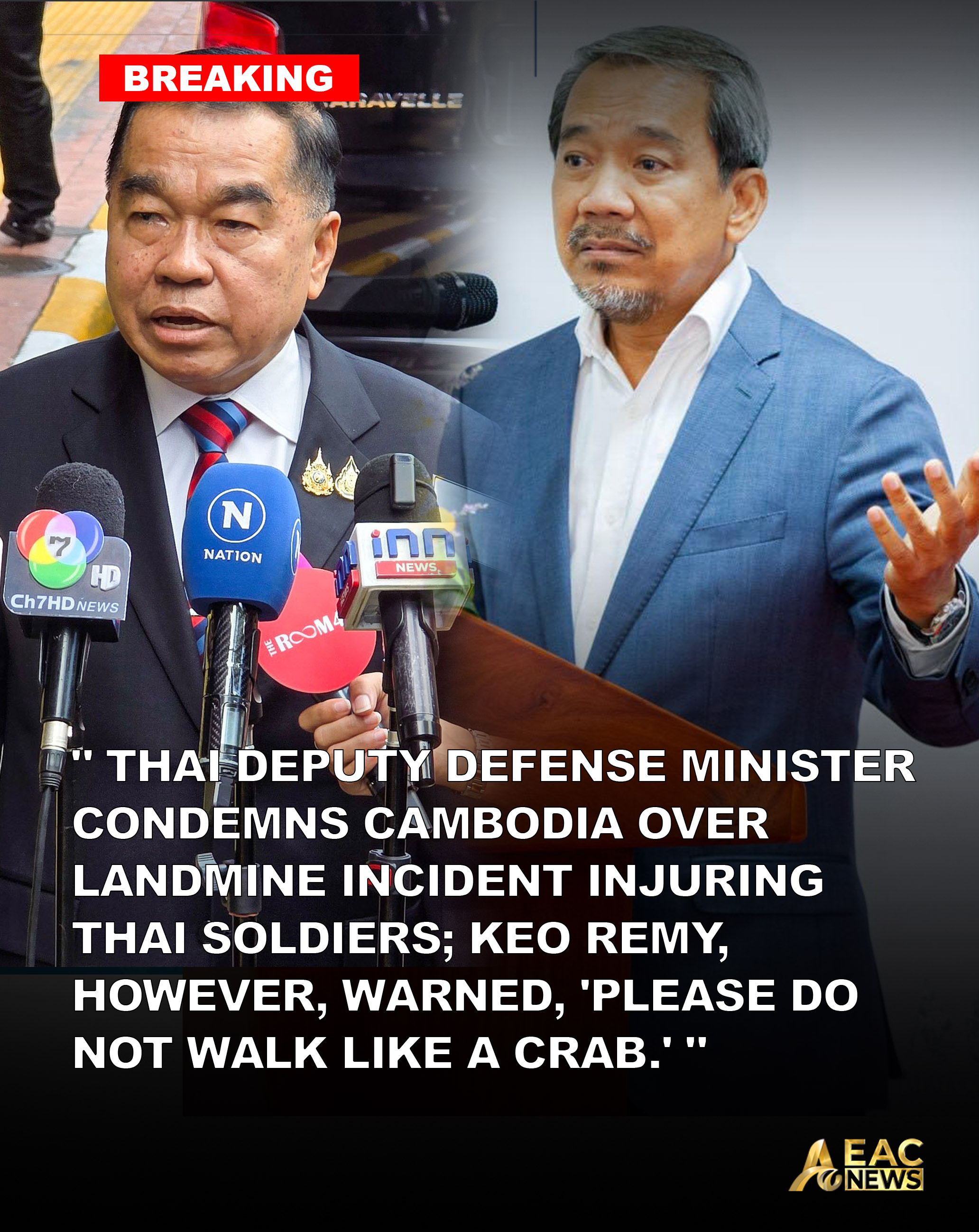
"Thai Deputy Defense Minister Condemns Cambodia Over Landmine Incident Injuring Thai Soldiers; Keo Remy, however, warned, 'Please do not walk like a crab.'"








Phnom Penh, August 13, 2025 — In a stern statement issued on August 12, 2025, Thailand’s Deputy Defense Minister, General Natthaphon Narkphanit, condemned Cambodia following a recent landmine incident that resulted in injuries to Thai soldiers during patrol operations within Thai territory.
General Natthaphon expressed his deep concern and disappointment over the incident, asserting, “I would like to express my deepest condolences over the incident in which our Thai soldiers were injured by anti-personnel mines laid by the Cambodian side while conducting a patrol mission within Thai territory. This constitutes a clear violation of our sovereignty, a breach of the Ottawa Convention, and an inhumane act by Cambodia.”
He emphasized the Thai government’s commitment to its personnel, stating, “As Deputy Minister of Defense, I affirm that we will fully look after and provide compensation to all personnel injured who have served with sacrifice in the line of duty.” The official reiterated Thailand’s determination to safeguard its sovereignty and security, assuring the public that security forces would not remain idle in the face of such threats.
Furthermore, General Natthaphon called on the international community to take action, urging global partners to press Cambodia for urgent cooperation in landmine clearance efforts. “I urge the State Parties to this Convention to reconsider the effectiveness of your assistance and the sincerity received, and to seek additional measures that will help prevent further loss of life from such merciless acts,” he added.
In Phnom Penh, Senior Minister and President of the Cambodian Human Rights Committee, Keo Remy, addressed the incident, expressing concern for the safety of Thai forces and providing historical context for Cambodia’s landmine issues. “I have good intentions for the Thai army. Please take this landmine issue seriously because there are many types of landmines left over from the civil war in Cambodia,” he explained.
He recounted that, during the 1980s, Cambodia’s border regions were heavily mined—ranging from aerial mines, landmines, to tree-planted devices. These mines were often left in place after periods of conflict, particularly when Cambodian forces set up defensive positions and withdrew without removing them. The situation has left a dangerous legacy, posing ongoing risks to civilian and military personnel.
He urged the Thai army to exercise caution and avoid reckless movements near mined areas, emphasizing the importance of adhering to safety protocols. “Please do not walk like a crab,” Keo Remy warned, highlighting the need for careful navigation to prevent further tragic incidents.
This incident underscores ongoing tensions and the lingering dangers posed by landmines in the region, emphasizing the importance of international cooperation in mine clearance and safety efforts. Both governments face calls to address these hazards swiftly and collaboratively to prevent future tragedies.
Related News